Evolution in Online Permaculture Training

Great trainers are sharing, motivating and supportive. They practice what they teach with a range of examples. And they are familiar with other cultures and environments, not just their own. And the online teaching space has evolved as people have become more familiar with the internet. I have practiced and taught Permaculture for 35 years. Now it is time to share some insights and growing concerns for the future of online training.

35 years evolving

My name is April. And few people know what I do, which suits me. I don’t want to be a celebrity. I enjoy the freedom and flexibility of anonymity.
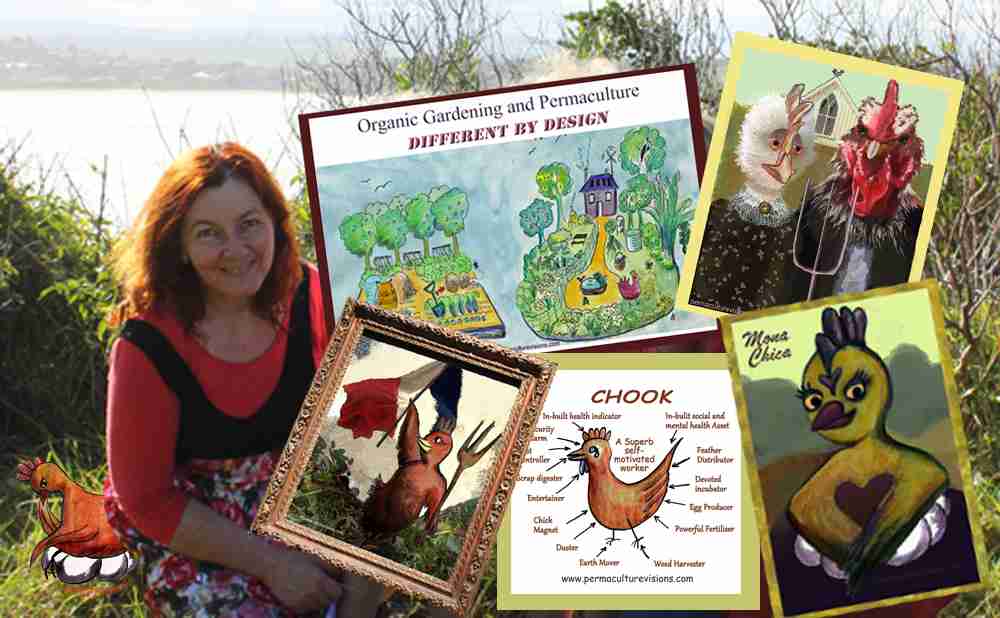
My father was a soldier in Vietnam. So, my early childhood was spent on an army base. There a lonely clump of bananas surrounded the septic tank. There were no bird calls. All I heard was dogs howling. But when we settled in Wollongong I was suddenly surrounded by beautiful beaches and forests. And a strong sense of place and belonging.
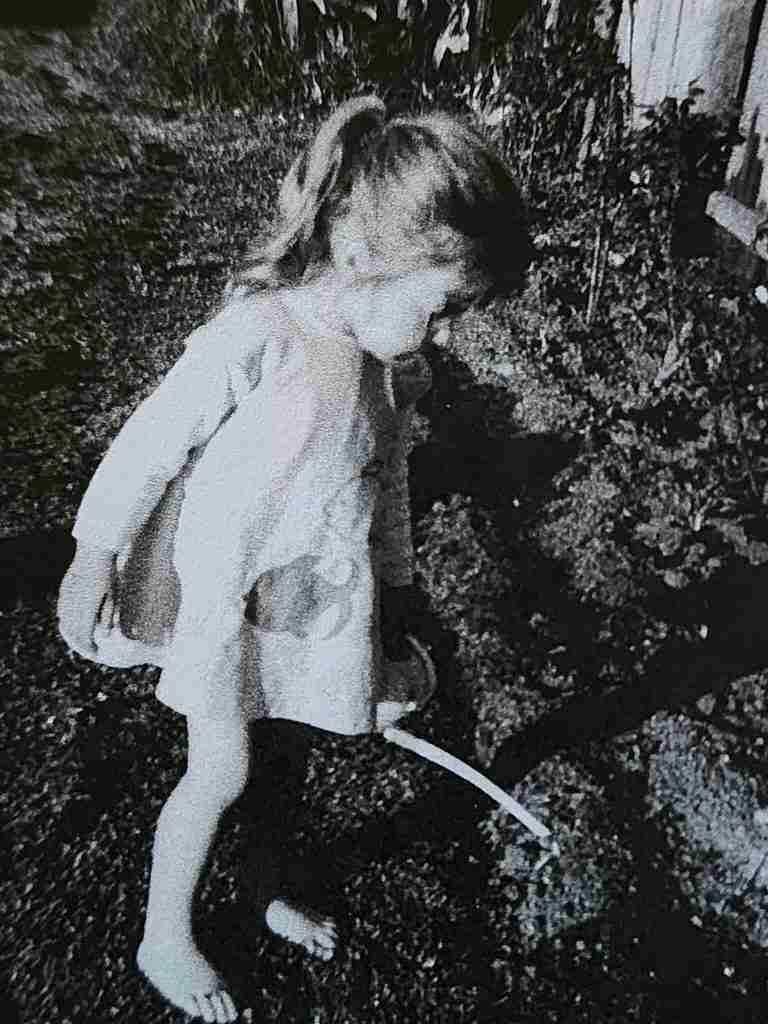
My mother was a great gardener, artist and hard-working book-keeper. But my father wanted me to be a software writer. He believed that computing was the future and people would work less. And so, in 1986, I got a computer trainee-ship at the local university. By 1993 I had some basic computing skills and a supportive partner and mother. I also had a masters in Creative arts. I knew how to research. And I knew how to teach complex skills. And I had a baby and a toddler. So, I knew how to work. I still loved my environment. And I was fascinated with Permaculture. And I wondered how it would fit in the emerging world of the internet.

Life and Death? of Internet

At the dawn of the internet, Computer games and internet pages were painfully slow. And they had no graphics. You had to use a lot of imagination.

But the fun thing about making content for the internet was the equality. Gender didn’t matter. How you looked didn’t figure. Content was all the mattered. And so, in 1996 with the help of my family, we set about to create the first online Permaculture course.

In 1996, my mother and I drove across Australia. We visited my birthplace in Perth and went to the great International Permaculture Conference and Convergence. Thanks to the tireless work of Ross Mars and Permaculture west, the proceedings are still available.
There I met a lot of amazing Permaculture people. And at the Convergence, I saw a small discussion group in a back corner talking about Information Technology [IT]. I told them my idea to start online teaching and they all started offering support. Even Bill Mollison chipped in and said he thought that online teaching could work. And I knew there was a need. Especially for participants in isolated places and working mums like me.

Land-based Permaculture Design Courses are often run by charismatic leaders. So, to make online training successful we offered something different. Our online courses were self-paced, flexible, organised and tailored for the student needs. Also, we adopted a student-focused approach. And I applied my research experience, enthusiasm and applied knowledge to explore many aspects of Permaculture. But it is difficult to keep participants enthused via email so a lot of people dropped out. But those who were self motivated became exceptional graduates.

Internet Choking

Now, internet users have to navigate past information pollution – ‘Infollution‘. Getting past excessive, unreliable and irrelevant digital clutter hampers and impairs decision-making. The modern educator needs to guide participants in their research with clear pathways. And offer strong avenues of support.

Slowly Maturing

After 20 years I started digging deeper, asking more. And I was truly lucky to have an informal mentor in Stuart B. Hill. I could ask Stuart questions and he would answer straight away. And for this I am forever grateful. I started to develop skills in deep listening and set about to interview many elders.

Decades later, we had a vibrant food forest, supportive community and creative fun. Ted Trainer said – it is not work if you are having fun. We worked and we had fun.

3 functions of Education

1. Share knowledge and ideas for a wide range of conditions.

2. Motivate and support participants into action

3. Connect people through community and integration with their environment.

Sharing Knowledge and Ideas

Knowing how to do something doesn’t mean we know how to teach it. Teaching is a craft in itself using psychology, and communication systems. Content knowledge (CK)is fundamental. This is the mastering the Permaculture skills – the knowing of what, why and how this work. On the other hand, Pedagogical knowledge (PK) is knowing how to help others become skilled. And the third knowledge needed for online training is a framework and method for keeping people on their learning pathway. It is easy to fall off the internet surfboard.

At the core, teaching or demonstrating Permaculture introduces holistic thinking. Then it sets about to pull apart the parts. And finally we work on how the parts interact. There is a lot happening in a Permaculture system. And complexity is tricky to show in modern bite-sized chunks.

Instructors also need to show how they applied the principles in their own practice as well as other situations. And help their participants find out more about their situation. In reality, the sharing of expert know-how is never going to come from one person. It will come through a conversation with many pioneers.

This is the strength of the Permaculture movement. We share. We converses. And, we are generous.

Motivating and Supporting

When we motivate participants, we need to follow through. Our support mustn’t end when the course ends. This is where the social design is essential in the growth of Permaculture. Teachers must foster others. The traditional formal education system in the western world has a deeply entrenched economic and academically competitive framework. We must do better. We need to learn from one another, support good work and foster diversity.

Connecting and Providing Ongoing Support

We all grow when we build a network of experts and a community of knowledge keepers.

All training requires an understanding of the work, an ability to break it down, then reconnect the ideas. But online training has extra pitfalls. Online participants are at risk of being disconnected from their peers, their dreams and trainers. And few trainers can afford to commit to supporting their participants for years. What we need to foster is a community of trainers.

Become part of our new mode of Permaculture Training. Contact us to join our Online Advanced Permaculture Design course community.

Seeking a Richer Yield

Yield feeds and energizes us. But how can we have an attitude of obtaining a regenerative yield rather than one that is merely extractive?

We can build systems using natural techniques for edible and useful products.  With clever design we can use natural systems that are productive as well as regenerative.  

Better still, we can apply permaculture thinking to social structures such as courses. In March we are releasing the test run of our Advanced Permaculture Design Course. We will question what yields can result from a course. What can a participant get from a course that they can’t simply glean from the internet?

3 Basic Yields

1.  Product yield: the resulting goods from a managed system. Physical yields include fruit, grain, herbs, animals, medicine, materials.

2.  Energy yield: stored and generated energy sources. Energy yields include increased efficiency, fuel, solar heating, gravity as in water storage, food preservation techniques.  

3.  Social yield: cultural benefits include security, creative and co-operative activities. “We see the invisible yields in terms of values and ethics.  This governs our concept of needs and sets the limits of enough.”  [B. Mollison] Social yields include time efficiency, creativity, community skills and structures and safety.

C.S. Lewis wrote about friendship, a social yield: “Friendship is unnecessary, like philosophy, like art….it has no survival value; rather it is one of those things which give value to survival.”

blobid0.jpg

Time and Yield:

Mature systems store energy with low maintenance regimes.  Old forests, large fish and animals maintain their large structures. So, some of the energy and nutrients they absorb is dedicated for maintenance. It is readily available as a or ‘yield’ for other elements.  Yes, these big structures can be a host to other living beings. But, the need for maintenance reduces the flow of energy through the system. It locks up energy and stores it.

There is great diversity attached to this maturity. And this diversity provides resilience and a long term yield. This includes habitat, food, shelter, clothing, security, warmth and shade. Also there are cultural values attached to the environment, broader animal community, sense of place. And long term gains from management of air, soil and water pollution. When we integrate mature forest systems with short-term agriculture the yield is richer.

As the system matures, we manage yield expectation and value the total yield.

Annual foods versus Perennial foods

Annual foods are foods that are produced by plants that live only seasonally. These plants are common in the modern diet: wheat, potato, most salad greens and most vegetables. Annual plants spend very little energy on self-maintenance.  But conventional annual agriculture has a very high energy cost per crop. And the management of the soil that supports these plants is expensive. The soil is tilled, nutrients added. Then we select the seed, plant the seeds, protect them, water them, remove weeds.

In a Permaculture system we can use animals to prepare the soil, remove weeds and kill pests and disease. There are some modifications that would reduce this cost. These modifications include hybridisation of seed, natural seed dispersal, rotating crops and creating rain water harvesting channels. We can also select varieties of foods that are adapted to our climate.

Cultural Change

The biggest challenge required can be a change in our choice of food types. Changing dietary habits is very difficult. It is cultural. And pinpoint the need for cultural change if we seek permanent, sustainable future. As we age we become less willing to try new foods.

We also need to build the knowledge of how to prepare these foods for optimal nutritional value. Much of this knowledge and skill can be learned from other cultures, especially tribes where bio-regional food are indigenous. A good example of the difficulty to change diet is Cuba. In Cuba, white bread was first introduced 500 years ago. And is still eaten daily yet Cuba does not grow wheat. The small population of indigenous people successfully grew Cassava and yet, this food was not adopted due to cultural preferences.

Perennial plants include only a few common vegetables like asparagus, buckwheat, rhubarb, and most fruits and nuts. Perennial plants store energy; they take longer to produce a yield and need to spend energy on sustaining themselves.  After maturity they produce less useful yield per energy used. On the flip side, perennial plants require less management (we plant, prune, mulch and provide some water). 

Side Yields

The structural effort by perennial plants provides many side yields. These include fine timber; habitat for nurturing young plants and animals. And micro-climate creation by producing of shade and condensation; and windbreak and shelter.  A poly-culture enables all the yields to contribute to the health of the farm and provides mixed marketable products.

Farmers like  Charles Massy, Martin Crawford, Mark Shepherd aim for both short term and long term yields. Diversification ensures a healthy combination of plant types for healthy total yield. We can install water catchment measures, build healthy soil, filter river water, and support wildlife. The yields also include deflected wind, reforested steep slopes and ridges, wildfire management and reduced pollutants and erosion.

permaculture_farm_Ideas-1024x601

Calculate Total Yield

The total yield of a farm includes side products. Side projects often include income from visitors to seasonal camping grounds for wild-life lovers. For out of season periods, the area can be grazed. Farmers can also offer education programs for city-dwellers, native foods farming and sales.

Social Yield

When applying this thinking beyond land based systems, we can search for yields beyond the short term. For instance, a social enterprise can have quick income streams and long term influence. It can create long term cultural change. Charles Massey wrote that there was no point in only creating change on his farm. He realized he needed to help enrich the whole water catchment area. The success of one area inspires many others.

Upcoming Mentorship session will focus on Yield

Our first mentorship session is March 18th. The first part of the session will be devoted to introducing each participants current projects. Then the Second part is an exercise to explore different types of yield from your projects.

This session satisfies assignment requirements for PDC Natural systems and design and Advanced Permaculture Design assignments for facets 1, 2 and 3

Contact us to REGISTER for the online mentorship sessions.

Deep Look at a Permaculture Element

For 40 years, Permaculture designers have been using a design technique called ‘analysis of an element ‘. This tutorial helps you get comfortable with defining, prioritizing and analyzing an element. Then you will be more effective in using it, and connecting it with other elements in your design.

Hazards and Benefits of Deconstruction

This a tool for understanding components of a system. This tool reveals a few insights. But over time and with practice and observation, you will start to notice a lot more. You will create a design that will help the inhabitants to grow. Because the natural system is not a machine. It is a living organism that wants to grow and change. And everything within the system wants to express its full potential. Breaking the system apart to examine the elements doesn’t reveal the synergy, the way things work together. This analysis tool is limited, but it’s still useful when developing a holistic design.

Observation is the most important activity

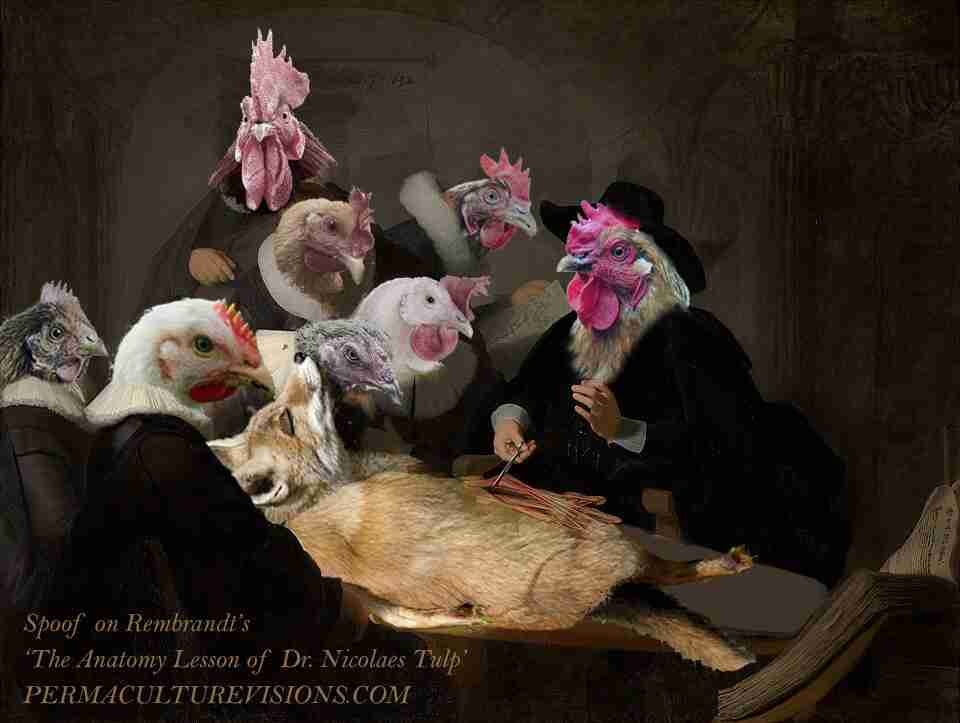
We can look at a chicken and see all its anatomy. See its personality. Then look at its needs and what it provides. And we can also see how one chicken is different to another – we call that the Intrinsic characteristics. The needs can come from a food forest, food scraps, its enclosure, the tank, a hose, and some shallow dishes. And the functions, the things that it provides can go to our kitchen and back into the food forest.

What is an Element in Permaculture Design?

In Permaculture design, an element is a part or a set of parts in a system. It can be a tree or a wood lot. Generally, an element is something that is independent of other elements. It is able to function on its own. However, it often needs inputs from other elements. For example, a tree needs sunlight, water and minerals.

And an element produces stuff that needs to be managed. The tree provides shade, leaf litter, fruit, lumber, humidity, carbon sinking habitat. A tree is an element that has needs, many functions, and each one can be intrinsically different.

Remember that a good design is not about what you have, but how it works. So, function has to be our first priority. There has to be at least three functions for me to get an element.

using the pizza oven
April and the Pizza oven

Even my pizza oven does three things. At least three things. It helps clear up a lot of dead wood. It cooks pizzas and then bread and cakes and things like that. Once it cools down, it provides ash and charcoal and I make biochar in it. And when we have pizza parties, the pizza oven is a wonderful way to socialize as you cook. And as a bonus, the pizza oven is a sculpture made with broken tiles and ceramics.

Needs

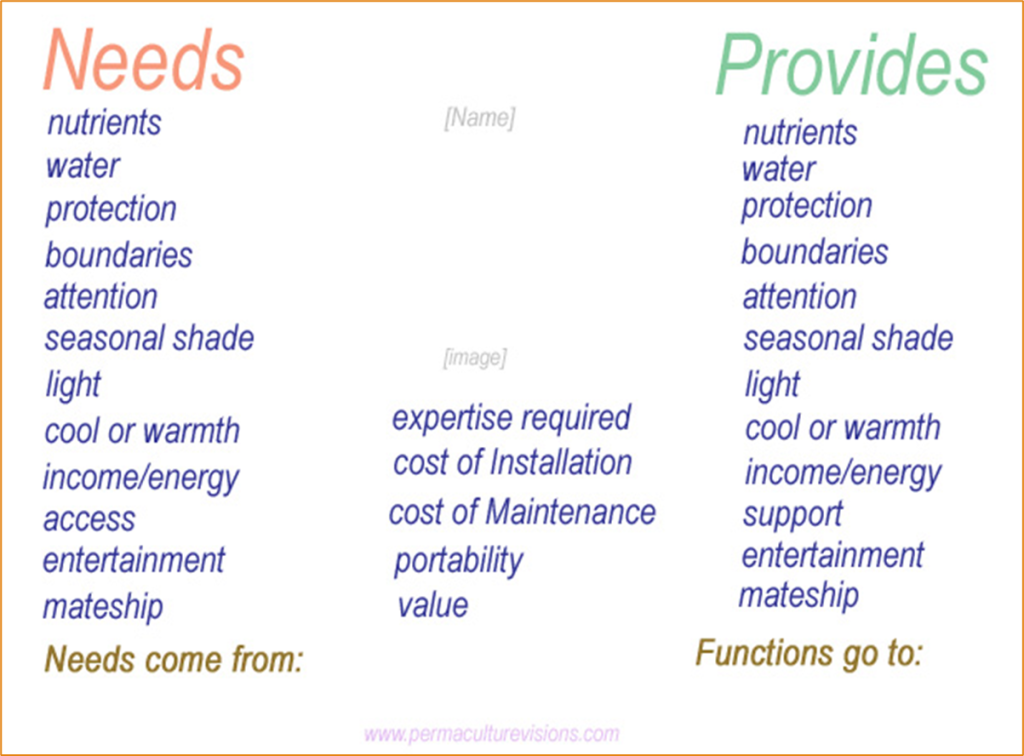
Most elements need nutrients, water, protection, boundaries, attention, seasonal shade, light, cool or warmth. We can call that generally climate control. Some elements need income or energy, access, entertainment, and mate-ship. And we would be wise to prioritise those needs.

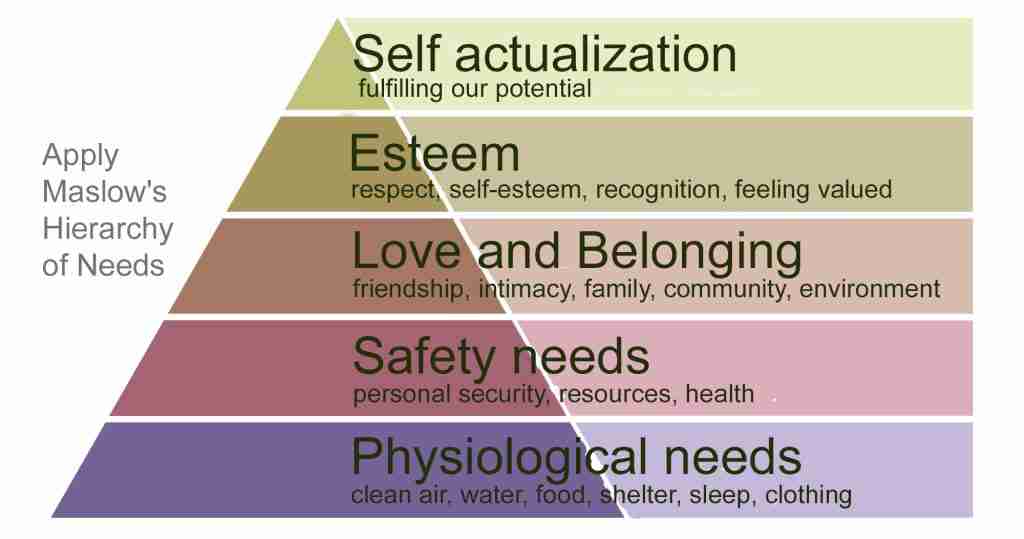
Here’s how Maslow prioritized the needs for people. Maslow said how the physiological needs, our needs for clean air, water, food, shelter, sleep, and clothing were fundamental. And then as we go up his hierarchy of needs, we would dream and hope that we could achieve self-actualization. We can hope to reach our potential. When an element is fulfilling its full potential, it’s happy and it’s being used well.

Some Elements are not Needy

There are some elements that don’t have any needs. And these can be vital elements like water, air, rock. They don’t have needs. So our needs emerge from our need to manage them. Water, as I said, doesn’t have any needs, but we definitely need it. And so we have to manage it. We’re going to capture it, store it, and use it.

Example: Rocks


Rocks or minerals are another element that have no needs. Rock cliffs have no needs at all, but they have a powerful influence as a windbreak, thermal mass, reflected light. Security can be achieved with cliffs. Think of all the castles on the cliff tops. Minerals come with the rocks. And you can have water harvesting from the top. And it is also really great building material.

Chetro Ketl was built about 90 through to 1140ce. It’s a great example of architecture that used the nearby cliffs. The scholars have estimated it required half a million work hours to build. And 26,000 trees were required to make this beautiful palace. The palace was made of 50 million sandstone blocks from the nearby cliffs. But the loss of trees and overpopulation caused the valley caused to become unliveable.

The design process must consider the natural function of each element. What do cliffs normally do? They erode. They collapse. So this design hadn’t predicted the potential impact of the cliffs on the housing and animals.

So let’s consider how do we meet the needs? The needs of an element can be creatively sourced from another element. Here you can see the nutrients could come from rock, seaweed, shells or plants and animal manure. There’s many different options.

NEEDSUPPLIER 1SUPPLIER 2
NutrientsRock, Seaweed, ShellsPlants or Animal manure
WaterRainCondensation
BoundariesFencingHedge
Attention/ManagementExperienced animalsPeople
Seasonal shadePlantsWoven shade
LightDirect SunlightReflected sunlight
Climate controlThermal massAnimal body heat
AccessPathwaysTunnels
EntertainmentSeasonal changesOther beings
Mate-shipCompanionsOther beings

Products from an Element

Now let’s look at how we use the ‘waste’, the throughput or the production of an element. These products can be absorbed by another element. And they can be absorbed through a means of natural tendencies, gravity, wind, chemical absorption.

The nutrients are beneficial for many other beings. But not straight away. Right? So the nutrients, the poop, from the chicken, is not going on my table! But it goes to the garden, a tree, and from the tree, it comes into the fruit. Then the fruit comes to me.

A chicken wastes very little water. And this waste is useful to the food forest.

As for providing boundaries – chickens don’t really provide boundaries except to their own chicks. And as for providing attention and management? Well, some people actually use their pets as a mental health tool. It gets them out of bed. It stops them from falling into great depression.

Seasonal shade is not provided by a chicken except to their chicks. And a chicken doesn’t provide light. But it will provide climate control definitely to the eggs and chicks. Also, some people are entertained by chickens. And one chicken can provide mateship to the other chickens.

PRODUCTIONUSERS
NutrientsAll living beings
WaterAll living beings
BoundariesPeople, Plants and Animals Especially Children
Attention/ManagementPeople – mental health
Seasonal shadeAll living beings
LightAll living beings
Climate controlAll living beings
AccessAll living beings
EntertainmentPeople & Animals
MateshipAll living beings

Putting Each Element Analysis on Card

Cards are tactile making it easy to use on a floor or table. Ask yourself, what does this element really need to thrive? And what can this element provide? What are its intrinsic characteristics? Then set your priorities.

For each element’s feature define the needs, the provisions, and intrinsic characteristics. And put a score to show the priority, whether it’s high, medium, or low.

Analysis of wicking bed

The needs of wicking beds are quite specific. They need level ground, a water input. Just use a hose off my rainwater tank, a protective barrier between the soil and the water reservoir underneath. I actually use hair because my son has a hair salon, so I’ve got a lot of hair. But coconut coir is a good mesh material and also old, cotton rags. Wicking vessels need protection from things like rabbits that could burrow beneath. Or large feral animals could knock them over. So, they do need protection.

Their functions that wicking pots provide include food. And joy for people like getting out and growing stuff. Recycled bird cages are pretty so they also provide cultural interest. And they start conversations about the benefits of not keeping birds in cages. And instead, keeping them out. The wicking beds in old bird cages become anti-aviaries.

The mobility of the small wicking beds is a bonus. But even if they’re one square meter, [a weighty cubic meter], you can hire a forklift to move them. My mentor, Judith Collins moved her entire garden with forklift and a truck because it was in large wicking containers.

Unintended products

It is also possible to integrate aquaculture into larger wicking systems. But one of the unintended outputs or through-puts in this system is the presence microplastics. Plastics are often used to hold the water. So explore safer materials like terracotta, metal, and glass.

Best Features of this Element

The level of skill needed to make and use the wicking bed is really low. And so is the cost of installation and maintenance is also low. And because they’re high portability, they have really high value to me. I take them to workshops and festivals. They’re a great conversation starter.


Fun with Element Cards

Once you’ve got a bunch of these cards, you can set them together. This reveals multi-directional connections.

See more about this in our video about integration of the elements in our YouTube channel PermacultureVisions. These will help you strengthen the relationships between these elements. Enjoy.

Outdoor Classrooms Inspire Next Generation

Janet Millington, co-author of best selling book that first introduced Permaculture into schools – OUTDOOR CLASSROOM. Janet talks about Zoning as applied to the classroom.

Carolyn and Janet created lots of curriculum material for teachers. In this interview, Janet noted “teachers were given so much stuff about school gardens. But they were they were boring”. As a result, Janet wanted teachers to “have it beside their bed. I wanted them to have it so they knew which page they were up to because there was a picture on every page.”

Following the publication of the book, Carolyn and Janet were invited to Europe to work with the children in permaculture. Then, the book was published in other languages and the biggest sales are now in Chinese.

Permaculture Zoning in Schools

“Zone one in the classroom is intensely supervised. Zone two just outside on the veranda.” Janet trailled this at Eumundi Primary School where the teacher observes from the the classroom. “Every time the kids walk past, they could see something, you know, like the leaves are going yellow or something’s eating our basil. Then zone three, teacher initiated learning. Zone four was learning adventures, anything related to the classroom, a playground, shelter, a stage and [here] it’s child initiated learning. So, that was trying to to negate that.. bare bitumen yard so that there would be areas that they could go and do things in. Likewise, the next zone is child initiated and directed. So, it’s making trails, forest areas, cubby houses, you know, all that sort of stuff. You’re releasing slowly the responsibility of the direction.

Zones One, two, and a bit of three is is teacher dominated really. But for the other zones children can say ‘I’ll take that from one, two, and three, and I’ll use it in four and and five when I’m allowed’.

Knowing where to start and how to guide children through learning experiences appropriate for their stage of development and prior experiences is a way to begin whole school planning for the outdoor adventure and and learning. And that’s that’s what we did in Eumundi when we when we first started. Each grade had their own speciality. I the early years, they study seeds and leaves and trees . And then some of the the larger concepts such as climate. patterns in nature and water came to the later grades.

Patterns in Nature – Beyond the Classroom

Janet said “I was living up in Cairns near the Atherton tablelands. A little two-teacher school invited me up to see their garden and do a little lesson. Oh, well, you know, I said ‘I’ll do the day’. But they said, “Oh, no. We’ve got kids from, you know, like infant school and primary.” I said, “Yeah, I can manage that.” And they added, “Oh, we might have some parents there, too.” I said, “They won’t get bored either.” So, I did the whole day showing patterns. And how it fitted in with things. From little kids to adults and they all got something out of it. They loved it. It was one of the best days of my teaching career.

Honestly, was just it all came together, you know, teaching and and permaculture. It was just was just a dream. It was just wonderful. I know. It’s nice when you get fulfilled. “

You can get your copy of OUTDOOR CLASSROM HANDBOOK at BOOKTOPIA.