Mentors boost your design skills, your yield, and enrich your habitat. Through these sessions you connect with others and discover inspiration. To have a mentor to help with tricky decisions and to celebrate your achievements is truly special. Students and graduates with Permaculture Visions are now encouraged to drop in to our mentorship sessions on Wednesdays 7-8.30pm AEST. If you can’t make it, you can send in a question and we will record as we discuss options.
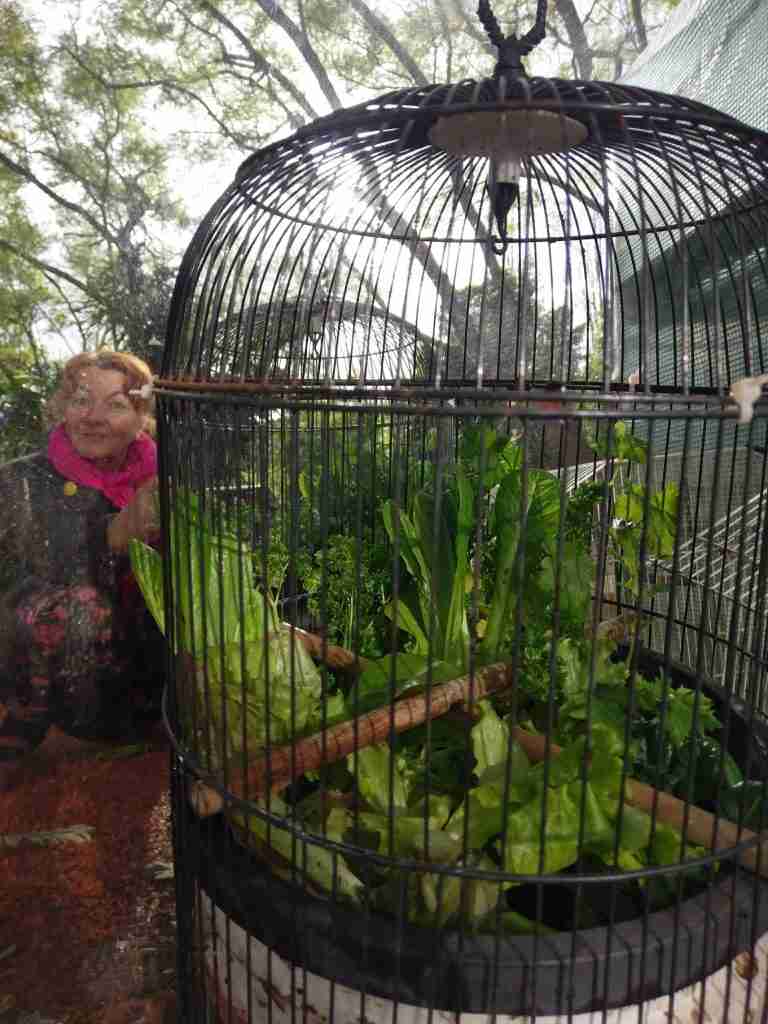
April chatting with her mentor Stuart Hill
What can a Mentor offer that AI can’t answer?
A mentor has real life experience. A mentor has also seen a lot of different scenarios. Also, a mentor has made some serious mistakes. They learned a lot from the mistakes. But best of all, they had the resilience to bounce back and push on.
Wisdom and Courage
When we started our food forest in 1993, people would comment that chickens would compact the soil. But the wise mentors pointed out, that if we observed the chickens and noted how they interacted with the site, we could reduce harm and increase the benefits. Our chickens are integrated pest managers. They are an essential part of our weeding regime.
Social Connections
Mentors help build social networks. Mentors give a little boost of encouragement as well as ask questions about ill considered consequences. Through active listening, mentors guide us and each mentor feels valued.
Mentorship Sessions are now available for Permaculture Visions students and graduates. Grab a cuppa, and drop in. In the mentor sessions you can choose to work quietly on your homework while you hear the prattle of other class mates. Best of all, share your project, ask questions and feel inspired.
On the October long weekend, in the pretty mists of Kangaroo Valley, NSW Australia, we will Unconference. Unconference you say? Yes, we will gather, set a mutually exciting agenda, harvest wisdom and ideas, regroup and share. We will lunch merrily, skite of fabulous dreams and procure gems of insight.
Tickets are genuinely limited
You know that saying, “getting in quick, seats are limited…blah blah”? Well, we’re sorry to say this is true. Due to the size of a secret venue and insurance costs, the tickets are limited to 100. But that isn’t a bad thing. In World Cafe thinking, those who are really keen will come and that brings an amazing energy to the gathering.
Past Permaculture convergences have between elders and designers, this one is open to locals so that it is grounded in the Kangaroo Valley experience. We will listen to the land and the people.
We are honoured to have Permaculture elders from Victoria and NSW join us for this grass roots gathering. Let’s gather wisdom and pool ideas to make Permaculture Design accessible for future generations.
Save money and save your environment with simple tricks to eat healthy, get smart-productive, be comfy and chill, enjoy being active and waste less. Permaculture is intentional design to create a truly sustainable culture.
Here a few design ideas to slip into your lifestyle.
1. Save Your Health
Consider what foods you love. And find an easy way to grow them. Lets make a cup of tea. Fancy lemon grass and ginger? That’s easy to grow.
And I love eating basil, so I grow it in a wicking pot with a cage over the top. I use worm poo as the soil in the pot and the basil is bursting with flavour. This small design cycle is simple. The Food Scraps go to the > wormfarm then > to wicking pot with basil seed then > to plate. Whereas farmed basil has a more complex and expensive pathway to grow and transport the basil. And it quickly looses flavour.
Eating healthily reduces costs in medical bills and loss of productivity. Not to mention our enjoyment of life.
2. Get Smart-Productive
A food that is self sustaining and very cheap to start in a warm temperate region is sweet potato. Buy a fresh sweet potato, let it sprout in the cupboard, cut off the sprouts with a small section of the tuber and plant it close to the surface of the soil. We can cook the leaves as well as the new young tubers. The cycle is Tuber to > soil > perennial food supply > better water retention and organic matter in the soil > more tubers.
Not only are you getting years of free food, you are improving your environment by protecting soil from erosion, holding moisture in the soil for cooling in summer and creating habitat.
To take this a step smarter, grow indigenous ground covers. In our area Dianella, Pigface and Warrigal greens are a smart choice.
And to take this food to a greater level of sustainability, cook it in a solar oven or rocket stove.
Be Comfy and Chill
Design to capture cooling breezes in summer and deflect frost and cold wind in winter. Explore your microclimates (inside and outside the home) and create shelterbelts.
Enjoy More Action
What activities do you love doing? Find a way to incorporate this into your lifestyle design. I like walking, so I have put in a labyrinth of garden paths. I make time to walk to friends places. And I campaign for better walking routes, water stations and public toilets. Continence Australia has developed a national public toilet map.
Recently, a design client said she liked running. Her running group share ideas, fresh food and observations about the local area. And as a bonus, active people need less heating.
Finding how to hook in to our passions and curiosity helps us build a better future.
Photograph in Beechworth hotel. Victoria, Australia
Waste less Save More
Do a quick audit of what you throw away. This will help determine how you can waste less resources and money. I know we throw away plastic from purchases. If I can buy less, I will have less plastic in our system. I also know that I throw out old clothes so when I buy clothes I ensure that they can be composted. The worms love some clothing for insulation and laying eggs.
learning to glaze old windows save a lot of money and provides opportunities to be creative.
For the past 30 years we have used our paper waste in the garden. We sheet mulched more than half an acre to suppress the kikuyu (saving hours of mowing each year), and now we use paper mâché to gently reshape the landscape, building path edges and swales with paper.
Join the Live Discussion
April Sampson-Kelly, a Permaculture Elder with over 30 year of research, writing, implementing, designing and living with Permaculture principles will give us hands on experience with solar ovens, heating tricks, seed saving, wicking without plastic and making gardens from paper waste.
Bring your lunch to enjoy at the Eco Garden after the workshop. After lunch April will be speaking on Climate Change Adaptation at our monthly gathering at the same location.
If you’re not yet a Permaculture Central Coast member, you can join us by visiting: https://permaculturecc.org.au/… Annual Membership fees are $20 for an individual or $30 for a family. Join today and enjoy access to all our events!
Dr Kim Loo is an active carer. She is inspired by her Permaculture garden, her Permie pod helpers and her patients. Kim is a member of Doctors for the Environment and other climate advocacy groups. She has noticed a big shift in people’s appreciation of the connection between health and the environment. In this interview she shares a lot of great ideas and encourages us to get active and finding joy.
What does Permaculture do for you?
Dr Kim Loo said “well I suppose in a way because my family are Buddhists and in a way it kind of aligns with Buddhism anyway in terms of the principles and the concepts, And it was just lovely to actually finally go to Permaculture and realize there’s a whole lot of people who are aligned with what I line with which is to protect nature work with nature and rewild my garden. I’ve never been super structured with my garden. I get edible plants that grow in outside areas. I leave them alone.
I’ve been a Doctor for 35 years now. We’re actually about to have our 35 year reunion from Sydney University Medical School. Health can’t be seen in isolation. Because health is impacted by all the systems around health. And the way that I approach health is the way a lot of my friends, who are doctors, approach Health.
Core of health – Biological and Social Determinants
We look at the core of health and the biological determinants of health. So, I ask what their family history is: whether there’s any vascular disease, whether there’s an anxiety depression, diabetes, cancers. Then I look at their health in terms of what they currently have how they live.
Then I also actually look at the social determinants. Because the social determinants of health is super, super important. My mother’s a social worker. So, being really cognizant of social determinants is really important. This includes where people are born, where they live, where they go to school where they work. And really how a person is supported. This framework determines how well they recover from any sort of mental or physical illness.
Commercial Pressures on health
And also then I look at the commercial determinants of health. This includes the tobacco industry, the alcohol industry, gambling industry, the processed food industry and the fossil fuel industry. All these industries are powerful Industries. They have deep pockets. And large marketing teams who don’t consider the health of the population. I ask ‘do they have gas at home inside the house? Indoor gas can cause asthma in kids and sensitize them for house dust mite. And I ask people to consider little details like not to idle near school drop off and pick up because their kids will be sucking in all that air pollution.
Environmental Determinants
And then I look at the environmental determinant of Health which is clean air water healthy soils, stable climate and a healthy ecosystem so you look at where they live do they have a space for walking in nature. Do they have a garden when I see a patient to look at all these determinants of health.
“If you don’t understand how people live, you can’t actually look out of them effectively” Physician Dr Kim Loo
How can people live well?
People can live well if they have to have somewhere safe to stay. And they can adequately keep warm when it’s cold and keeping cool when it’s hot. They have people around them to support them. And they have access to fresh food and skills to process fresh food. Because fresh food is more expensive than processed food. And wellness is also about how much they move during the day. A lot of people are quite sedentary. So, it’s good to get people to be ‘behaviourally activate’. Also, wellness depends on how they sleep.
Finally, we live well from having something that brings joy. With a hobby people thrive and not just live.
Advocacy for Systems Thinking
I’ve been in systems advocacies for the last 10 years so because it can feel quite overwhelming when you realize it is a systems problem. Because not everyone completely understands this. And there’s so much disinformation at the moment around. I encourage all my doctor friends. I’m in doctors for the environment. We do multiple things including trying to insert climate change into the medical curriculum in all the universities we have a sustainability team that looks at emissions from the really the hospital sector 7% of emissions in Australia from the healthcare sector. Not many people know this.
We also have ethical investment arms where we do internal lobbying and shareholder activism. A lot of banks own fossil fuel shares. We also continue lobbying for every single tree that’s going be cut down because the loss of biodiversity in Australia is terrible. So, we work with other groups like World Wildlife Fund.”
Kim Models Wellbeing
Kim continues “My tea each day is lemon Myrtle and lemongrass ’cause I’m trying to wean myself off coffee. I show it to people and they say ‘oh my God it smells so nice just to have create your own tea from your own garden. Once you establish this, it’s cheap. Instead of buying bags of drinks you are actually getting stuff from your garden. There’s a lot of groups that working together in alliances. This wasn’t happening 10 years ago. Now there is a network of people working together which is a great thing. Every time we have a local permaculture pod get together, sitting down eating with other people, we are creating a community of people who understand and care.”
Learn more about creating a lifestyle that is healthy for you and the environment. Enrol in our Permaculture Courses.