Dr Kim Loo on Permaculture, Joy, Wellbeing & Medicine

Dr Kim Loo is an active carer. She is inspired by her Permaculture garden, her Permie pod helpers and her patients. Kim is a member of Doctors for the Environment and other climate advocacy groups. She has noticed a big shift in people’s appreciation of the connection between health and the environment. In this interview she shares a lot of great ideas and encourages us to get active and finding joy.

What does Permaculture do for you?

Dr Kim Loo said “well I suppose in a way because my family are Buddhists and in a way it kind of aligns with Buddhism anyway in terms of the principles and the concepts, And it was just lovely to actually finally go to Permaculture and realize there’s a whole lot of people who are aligned with what I line with which is to protect nature work with nature and rewild my garden. I’ve never been super structured with my garden. I get edible plants that grow in outside areas. I leave them alone.

I’ve been a Doctor for 35 years now. We’re actually about to have our 35 year reunion from Sydney University Medical School. Health can’t be seen in isolation. Because health is impacted by all the systems around health. And the way that I approach health is the way a lot of my friends, who are doctors, approach Health.

Core of health – Biological and Social Determinants

We look at the core of health and the biological determinants of health. So, I ask what their family history is: whether there’s any vascular disease, whether there’s an anxiety depression, diabetes, cancers. Then I look at their health in terms of what they currently have how they live.

Then I also actually look at the social determinants. Because the social determinants of health is super, super important. My mother’s a social worker. So, being really cognizant of social determinants is really important. This includes where people are born, where they live, where they go to school where they work. And really how a person is supported. This framework determines how well they recover from any sort of mental or physical illness.

Commercial Pressures on health

And also then I look at the commercial determinants of health. This includes the tobacco industry, the alcohol industry, gambling industry, the processed food industry and the fossil fuel industry. All these industries are powerful Industries. They have deep pockets. And large marketing teams who don’t consider the health of the population. I ask ‘do they have gas at home inside the house? Indoor gas can cause asthma in kids and sensitize them for house dust mite. And I ask people to consider little details like not to idle near school drop off and pick up because their kids will be sucking in all that air pollution.

Environmental Determinants

And then I look at the environmental determinant of Health which is clean air water healthy soils, stable climate and a healthy ecosystem so you look at where they live do they have a space for walking in nature. Do they have a garden when I see a patient to look at all these determinants of health.

“If you don’t understand how people live,
you can’t actually look out of them effectively”
Physician Dr Kim Loo

How can people live well?

People can live well if they have to have somewhere safe to stay. And they can adequately keep warm when it’s cold and keeping cool when it’s hot. They have people around them to support them. And they have access to fresh food and skills to process fresh food. Because fresh food is more expensive than processed food. And wellness is also about how much they move during the day. A lot of people are quite sedentary. So, it’s good to get people to be ‘behaviourally activate’. Also, wellness depends on how they sleep.

Finally, we live well from having something that brings joy. With a hobby people thrive and not just live.

Advocacy for Systems Thinking

I’ve been in systems advocacies for the last 10 years so because it can feel quite overwhelming when you realize it is a systems problem. Because not everyone completely understands this. And there’s so much disinformation at the moment around. I encourage all my doctor friends. I’m in doctors for the environment. We do multiple things including trying to insert climate change into the medical curriculum in all the universities we have a sustainability team that looks at emissions from the really the hospital sector 7% of emissions in Australia from the healthcare sector. Not many people know this.

We also have ethical investment arms where we do internal lobbying and shareholder activism. A lot of banks own fossil fuel shares. We also continue lobbying for every single tree that’s going be cut down because the loss of biodiversity in Australia is terrible. So, we work with other groups like World Wildlife Fund.”

Kim Models Wellbeing

Kim continues “My tea each day is lemon Myrtle and lemongrass ’cause I’m trying to wean myself off coffee. I show it to people and they say ‘oh my God it smells so nice just to have create your own tea from your own garden. Once you establish this, it’s cheap. Instead of buying bags of drinks you are actually getting stuff from your garden. There’s a lot of groups that working together in alliances. This wasn’t happening 10 years ago. Now there is a network of people working together which is a great thing. Every time we have a local permaculture pod get together, sitting down eating with other people, we are creating a community of people who understand and care.”

Learn more about creating a lifestyle that is healthy for you and the environment. Enrol in our Permaculture Courses.

We research, share, and teach permaculture online. Thanks for supporting us.

Microclimates – Where to Find Them and How to Make Them

Microclimates are one the most valuable Permaculture design tools. They enable us to boost potential of a landscape, reduce our need for energy input, and increase resilience.

In a recent design for a temperate region, our design had keyhole gardens, suntrap orchard, windbreaks, structures, waterways and ponds for thermal mass, increased humidity via strategically placed, manure filled drains, and frost sinks. The design works with the sectors of the site and built diversity into the system for long term resilience.

Microclimates

Microclimates are small pockets of unique climate. These pockets usually occur due to the shape of the land and vegetation. The 6 main influencing factors that influence a microclimate are Sunlight, Wind, Humidity, Thermal Mass, Frost, and Surrounding Climate. The session also shows how to create and illustrate microclimates in your design.

Designing with microclimates helps you boost your use of natural energies to optimise comfort and production. You can design to work with nature to create the best living space. And best of all, your living space will have more natural light and warmth.

Image of sun smiling on a suntrap designed farm with Link to affordable Microclimates course on Udemy
Image of a suntrap designed farm and Link to affordable Microclimates course on Udemy

Using Free Energy Sources

Energy sources and influences create microclimates, we break this down for you. There are key natural energy factors that influence a microclimate. This course explores each factor. Valuing and using sunlight is vital. This course shows your how to create a suntrap. Next up we discover how to harness warmth and store it in different types of thermal mass. Next we use or diffuse wind. Cool elements such as winter wind and frost are also addressed. Finally, we look at lesser known factors such as altitude and geo-thermal influences.

Bananas love shelter from the wind from the hedge behind them. In turn, they shelter a basil crop.

You can create a range of microclimates in your own space: indoors and out. The simple action of redesign improves your lifestyle and growing potential.

Once you know how nature works, you can imitate it. The costs of comfort and production are reduced and our footprint on the earth is lightened.

Learn more with us. Enrol in our Permaculture Design Course.

I’ll Have What She’s Having – Ethics, Values & Simplicity

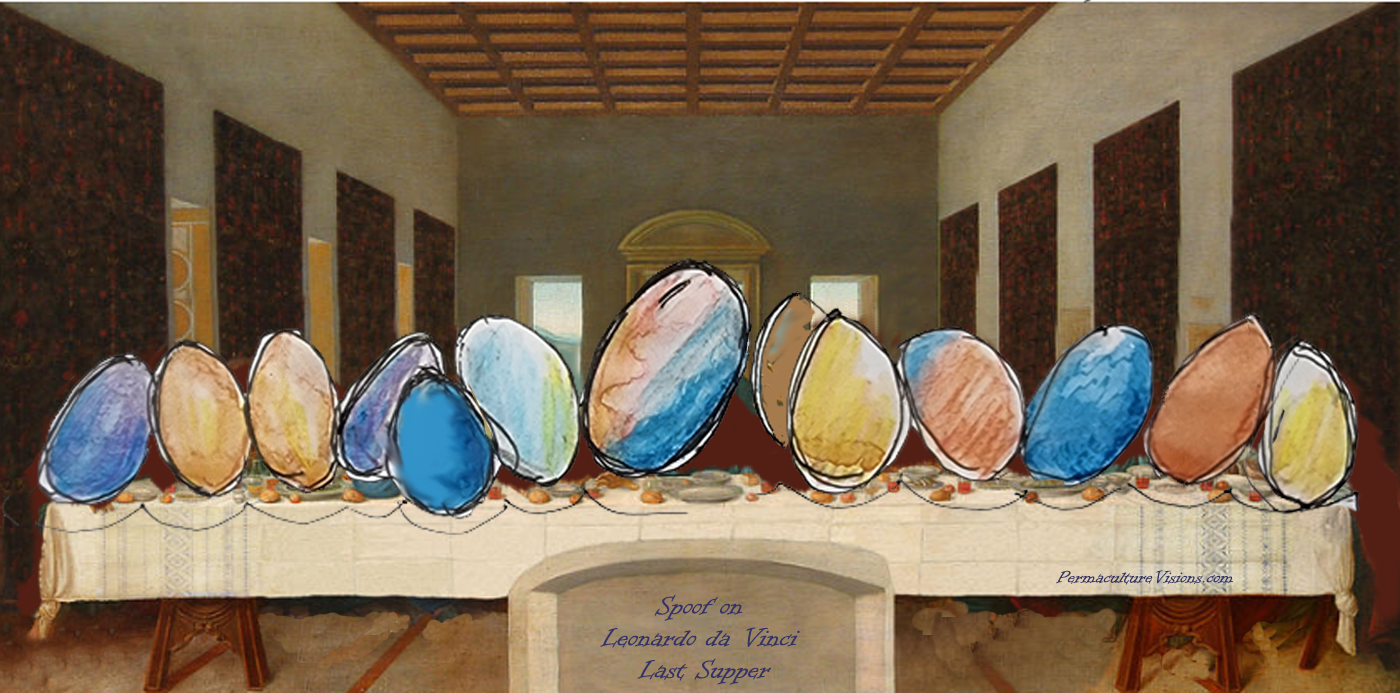
the last supper spoof with eggs

Do we really want to live by someone else’s design? Ethics enable us to find our core values, consider consequences and fuel our resilience. This design facet reveals the feelings and values behind the design goals. Here, we consider how ethics and values can influence choices and actions. And by asking about ethics of each person involved, we are building understanding and enriching the channels of communication.

Ted Trainer notes[1] “Our society is unsustainable. There is increasing environmental damage, dwindling resources, third world poverty, resource wars and falling quality of life. There is too much resource use” … So, “we have to change systems, not just lifestyles”. Ted goes on “We need to transition to new ideas and values”. Ultimately, “the point of life must be enjoying it without wanting to become rich.”

An attitude of simplicity, of moving away from one of acquiring wealth, benefits 99% of the world’s population. Only the mega rich 1% will hindered. But let’s not assume everyone understands the impact of this unsustainable economy. Because if everyone did understand the causes of inequality, the system would change quickly.

Ted Trainer on how to achieve the SIMPLER WAY

Ted also talks about rejecting ‘perfectionism’. He says near-enough is good-enough, “as in my video”. Ted continues to be entertaining into his golden years.


Change Starts with Ethics

There is no great mystery about how we might change architectural practice to minimize present and future harm. Technically, we already know how to build in ways that are not only less harmful, but that can be actively regenerative. Amica Dall So, where is our will to change? The will to change comes from our core values.

Amica Dall writes “Architecture is powerfully life-affirming, but the life that it affirms is uniquely human, and severs us from that which we depend on. Looked at from a distance, its power is not quite illusory, but also not quite solid either. It only holds so long as we continue to ignore everything that is outside the boundaries of the drawing, all the thousands of interlocking transactions and processes required to bring any single element to site and all the harm embedded in them, both now and in the future. Along with mass manufacture and industrial agriculture, architecture is one of the practices that is most responsible for creating and sustaining the collective illusion that we have mastery over the world and can bend it to our will.“

Dall continues “The challenges that are harder to overcome are social, and have to do with the legislative and financial instruments that support and enable construction.” We must reset cultural expectations and embrace retrofits, like the art of Kintsugi. We need to invest in elegant retrofits. And stop striving for perfection. There is joy in simplicity and contentment.

Self reliant elders

Set Your Goals Last and Build Values First

Stuart Hill urges us to be driven by our ethics and values, feelings and passions rather than particular goals or resolutions.  By revisiting our ethics and values at the end of the year we can keep the positive fire burning.

By listening to our feelings and passions we give ourselves the energy to create a better future. Though acknowledging our passion we formulate a vision, purpose. Once our passion is invested in our future, we can find energy to develop goals, and sustain the plans and activities.

  1. Question your ethics and core values
  2. Acknowledge your feelings and passions
  3. Research your ideas, visions and design (doing this permaculture course is a critical tool in developing systems thinking and building your own design)
  4. Create action plans
  5. Finally start the regular activities that will help you realise your goals. At the end of each day, set goals that help achieve the actions you set in your plan.

Hill urges us to:  “Act from your core/essential self – empowered, aware, visionary, principled, passionate, loving, spontaneous, fully in the present (contextual) – vs. your patterned, fearful, compensatory, compromising, de-contextual selves”

Core Values for Social Permaculture Design

Every person is different. No two permaculture designers will have the same passions and goals. Here are two different applications of Hills suggestion to act from your core self.

Enjoy your personal journey of regeneration. Start with your inner landscape. This transforms our interactions with others and the world around us. And ultimately, leads to cultural change – a more permanent culture.

Learn more with us at Permaculture Visions

Permaculture Wendy in the Kimberly

la nacita di venus - bottichelli as a chicken

Discover Wendy Albert and her permaculture food forest in the Kimberly. She lives and teaches in the remote hot wet tropics and is part of a strong indigenous community. She is in one of the most remote places on Earth. Her Permaculture life is in the hot wet tropics, thousands of kilometres from the most remote city in the world, Perth. In fact, Wendy is closer to Bali than to most of her fellow Australians.

Wendy Albert talks about her mature Permaculture Forest

Wendy describes her amazing permaculture food forest

“The closest famous town is Broome which is 200k to the south. And then per the capital city is 2,000 K away to the South. The nearest other Australian big city is Darwin of course and that’s 2,000 K to the North East. Whereas Bali is only about 200ks by sea.

The Asiatic people had been coming here for a long time they have a history here not just from the pearling industry but from before that. They used to be Trang fishing. And so they brought with them a lot of plants like the Tamarind. And also a plant that’s well known in permaculture circles called mother of cocoa.”

Mother of Cocoa

Wendy said “When I learned about permaculture and started practicing it I looked for Gliricidia sepium or Mother of cocoa plants and I couldn’t find them anywhere in Australia.
I looked everywhere. And, in fact, I got some seed from America that didn’t germinate and then after months or so of searching I was at friend’s place in town and I said to her ‘what’s that beautiful tree with a lovely purple flowers?’ and she said ‘oh that’s Mother of Coco’.

Then I found that throughout the old areas of town both here in Derby and in Broome. There’s lots of those plants. They’re really hardy. So, they’ve they survive over a hundred years and they were brought here by the early Asiatic settlers who had to grow their own food. They didn’t have state ships and trucks and things bringing food from all over the country to them. “

wendy adding charchol to the sandy soil

Wendy adds charcoal to the soil

The community had to survive by themselves. “And so I was able to get cuttings and grow the Gidia and now I have a cocoa grove where the Gidia or the mother of cocoa are mothering the baby Cocoa trees as well as a lot of other trees. Because they just used to poke the stick in the ground and it grows! If you keep it down and then it just grows and grows. And you just keep cutting it and cutting it and adding it to the soil. Because that’s the other thing we need to do here is add organic matter to the soil.”

Mother of Cocoa nurses the Cocoa chocolate plant as well as many other plants in a tropical Permaculture system. It is used for many purposes including live fencing, fodder, firewood,[11] green manure, intercropping, and rat poison.[12] In fact, the generic name Gliricidia means mouse killer.

Beehive thriving in the wall of the huge prison tree near Derby WA

Nutrients cycles for the Tropics

Wendy says “I wish I’d known what I know now, 20 years ago! And I would have been able to do much more. I’ve recently had a couple of woofers, three young people, and we got so much done just in the the early hours of the morning with their muscle. I have to find a way to inspire young people around here to get into it. Because what I find is I’ve got all the resources now that I didn’t have when I started. That’s from growing those resources and recognizing what’s already there in terms of the the indigenous plants. And their use. And how to maximize their benefit. You know, people get frightened of pruning. But really, lots of plants respond so positively to pruning.”

How Wendy makes great soil

Wendy converted the orange, sandy soil to a diverse, productive food forest. She uses charcoal, organic matter, ferment and moisture.

Before Wendy adds organic matter she needs to add charcoal to the soil. “We make biochar basically because the nature of the soil here it’s pinned down and when the big rains come all the nutrients wash away. So, it’s really important to have a layer of charcoal to start with so that the microbes and the all the little odds and ends that like to live in the soil have got their own apartment blocks and can stay and not be washed away. That’s the basics for…..developing a thorough, thriving ecosystem here.”

Working with Nature

There is a striking contrast between Wendy’s site and the neighbouring properties. Wendy explained that the process for a permaculture food forest is complicated and fights the mainstream urge for people to demonstrate control. She lamented that one of the first things the young people are taught in horticulture courses is how to kill plants.

Wendy mused “we’re all people of habit and we rely on our education. And people come here and they see trees that grow so easily they don’t realize they’re legumes. They don’t realize the value of keeping them in the soil and just pruning them to encourage growth. And so they clear everything. They get a bulldozer in and bulldoze everything down. And maybe burn it. But they don’t you know utilize ash. They don’t burn it to charcoal. Then they try and plant other stuff. Southern stuff. Whereas the reality is we’ve got to plant what grows here what likes this environment, what can cope. If we want to be self-sufficient we have to learn to eat stuff that will grow in this environment. Potatoes that we’re used to from down south don’t grow here (only during the dry sometimes with a lot of care and attention).

Many layers in Wendy’s Permaculture food forest bursting with fruits, greens and staples like cassava

Tackling control and colonialism

There’s also the issue of control. “Control is a subconscious thing. When people don’t identify with the natural world, they think they’re in charge. It’s a colonial mentality. Control is just more colonialism. Getting control of things and taking what we want from the land instead of respecting the land and giving back to it. Giving back in terms of even waste our own waste. ie food waste. and so exchange is how nature actually works.

The Foundation of Perth 1829, George Pitt Morison, 1929, oil on canvas, 97 x 138 cm.
National Library of Australia 586293

That’s what people don’t understand. People, I think, see nature as something to utilize to use for their benefit and not they’re not part part of it. They don’t sink into the rhythm of it. And be. And give back in the same way as nature gives to us. We can’t keep getting fruit from trees if we don’t put something back. And our practice is to go and buy something from the hardware to put back in the soil ie. some manufactured fertilizer. I’ve seen people take truckloads of prunings from their trees to the tip then go to the hardware and buy mulch!

“We’re trained into this capitalist economic system. Buying stuff is what you do. It is the basis of how we live. We’re not working with nature and giving and taking. It’s more taking as much as possible. And making as much profit as we can”. Have your heart in the right place. This is a simple way to start. And it’s a scalable.

Easiest Ways to Start

“I’ve been writing a handbook about how to do it in the most straightforward and easiest way. Start in the kitchen with your own food. Even if you’ve just got a small backyard go and dig a trench and have a bucket on your sink. Put all your food waste in it and once a day go out and empty the food waste into the trench and cover it up. That’s the easiest way and then you can sort of upgrade from that.”

You can add Bokashi to it. “It’s a learning process. Understanding what what’s going on why we putting the food waste in the ground. And how can we utilize it to its best effect. And the other thing though is to get some charcoal and if you can’t have a fire yourself in your backyard we can go out into the bush where there’s lots been lots of bush fires and collect some charcoal. Chuck that in with with the food waste and that’s your start and this wet season buildup is the time to start. Mind you, the other thing to do when you cover the food cut some you know leaves of any tree you’ve got handy and put it over as a mulch to keep it moist. The other thing is to keep it moist.”

You can do the same thing in the big pot. Fill it up with layers of leaves, food waste, charcoal and soil from a friend. “Sophie Strand said ‘rot is the womb of life’. Tapping into that process. That’s what’s important.”